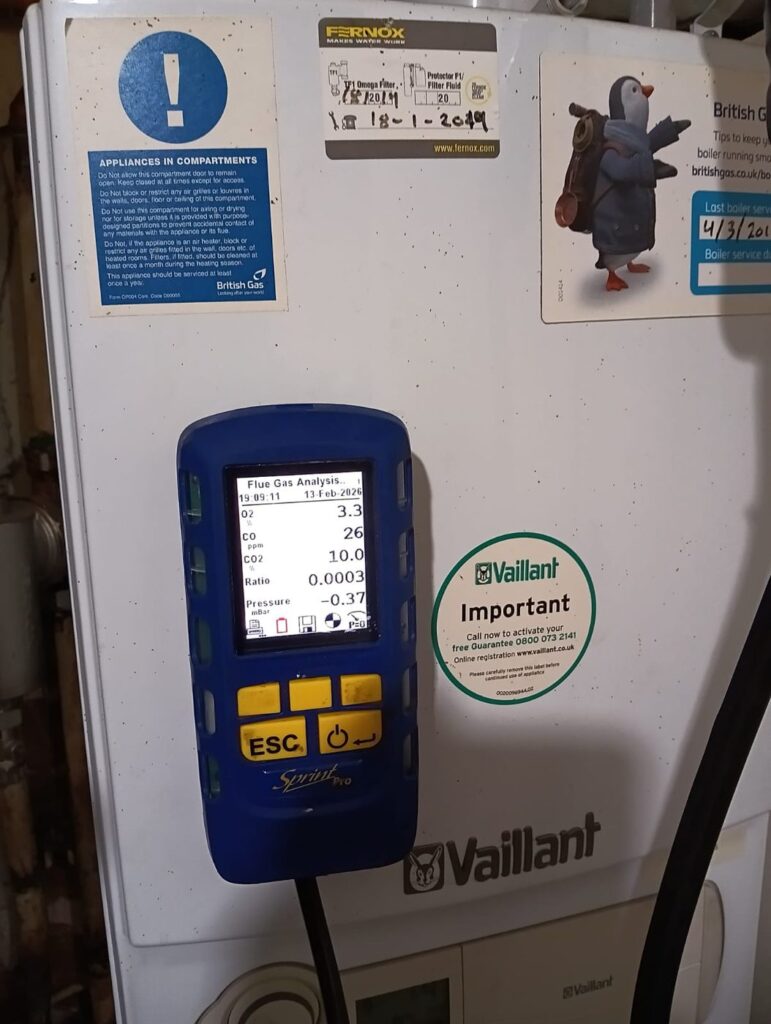
A proper annual boiler service is not a glance at the display and a sticker on the case. It is a strip-down of the working parts, a set of readings taken off a flue gas analyser, and a series of safety checks on the flue, the ventilation and the gas supply — and it usually takes between thirty and sixty minutes. The reason so many people are unsure what they are paying for is that most of it happens with the boiler’s front cover off, with their back turned. So here is the whole thing, in order, from an engineer who does several of these a day across Bow, Dagenham and the rest of East London — including the parts that most often turn out to be the problem.
What is the engineer actually checking when they take the cover off?
The first thing that happens on any service is not a spanner at all. It is a conversation and a look around: how has the boiler been behaving, has it locked out, is the hot water taking longer than it used to, are any radiators cold. Those answers change what gets looked at hardest. After that the checks run roughly in this order.
- Visual and installation check. Is the boiler installed to standard, is there adequate ventilation, is the flue correctly supported and sealed, are the pipes properly fitted and clipped. On older installs in Victorian conversions this is where non-compliant work from years ago tends to surface.
- Gas rate and operating pressure. The boiler is fired up and the amount of gas it is burning is measured against what the manufacturer says it should be. A boiler running over or under gas rate is either wasting money or struggling to make heat.
- Combustion analysis. A probe goes into the flue test point and reads the carbon monoxide and carbon dioxide levels and the ratio between them. That ratio is the single most honest number about how cleanly the boiler is burning, and it is the check that catches a problem before anyone in the house could notice one.
- Burner and heat exchanger. The burner comes out and gets inspected and cleaned. The flame picture is checked — a crisp, stable blue flame is what you want; yellow, lazy or lifting flames mean something is wrong.
- Condensate trap. On any modern condensing boiler the trap is removed, emptied and flushed through. More on this one below, because it matters more than people realise.
- Seals, electrodes and safety devices. Ignition and flame-sensing electrodes are checked and cleaned, case seals are inspected, and the overheat and flame-failure devices are tested to confirm they actually shut the boiler down when they should.
- System pressure and expansion vessel. The cold fill pressure is checked and the expansion vessel charge is tested. A flat vessel is one of the most common causes of a boiler that keeps losing pressure — we go into that in detail on our boiler losing pressure guide.
- Tightness test at the meter. A gauge goes on the gas meter and the whole installation is watched for a pressure drop. Nothing gets signed off until it holds.
At the end you should get a written record of what was checked, the readings that were taken, and anything we have flagged for the future. If an engineer cannot tell you what your combustion readings were, they did not take them.
Why does the condensate trap matter so much?
This is the part of a service that earns its money and almost nobody has heard of. A condensing boiler produces mildly acidic water as it runs, and that water leaves through a trap at the bottom of the boiler before it goes out through the condensate pipe. Over a year that trap collects a sludgy grey-brown deposit, and once it is restricted the boiler starts locking out — often intermittently at first, then permanently, usually on a cold day when the boiler is working hardest.
We take the trap out, empty it, flush it and refit it as standard. It is a five-minute job in August and a call-out in January, and it is the clearest example of why servicing in the quiet season is worth doing. The same logic applies to the pipe that trap drains into: if it runs outside — as it does on a lot of East London installs where the boiler sits on an external wall — it can freeze solid in a cold snap and stop the boiler dead. Our guide to a frozen condensate pipe covers how to spot and thaw one.
What do we find most often in East London homes?
Three things come up again and again, and they are all specific to the housing and the water round here.
Scale, because East London is a hard-water area. The water supplied across most of E3, RM10 and the surrounding postcodes is hard, and that means limescale forms on the hot surfaces inside a combi boiler’s plate heat exchanger. The symptom is hot water that runs warm rather than hot, or that swings temperature while you are in the shower, and often a kettling or rumbling noise as the boiler heats. It is why we check the flow rate and temperature rise on the hot water side rather than just confirming the taps run hot.
Iron oxide sludge, especially in the older housing stock. The 1930s Becontree-era houses around Dagenham and Barking frequently still have some of their original steel pipework in circuit with a modern boiler. Steel plus water plus years equals black iron-oxide sludge, and it settles in the bottom of radiators. If a system has a magnetic filter fitted, the magnet tells the story instantly — a magnet that comes out caked in thick black paste means the system is loaded. Cleaning that filter is part of the service; if the system is genuinely heavy with sludge we assess it properly and explain the options rather than reaching straight for a power flush.
Flue terminals that have disappeared. In the Victorian terraces around Bow and Mile End the flue very often exits into a narrow side return, a lightwell or a shared alley. Ivy grows over it, a bird nests behind it, or a neighbour’s fence goes up eight inches from it. A partially obstructed flue is a genuine safety issue, and checking it means physically going outside and looking at the terminal — not just at the boiler.
Is a boiler service the same as a landlord gas safety check?
No, and it is worth being clear about the difference because the two get muddled constantly. A gas safety check answers one question: is this appliance safe to use right now. A service answers a broader one: is this appliance clean, correctly set up and going to keep working. The safety check is the legal duty for landlords, renewed every twelve months, and it produces the CP12 record — our landlord gas safety certificate page sets out exactly what that involves. A service includes safety checks but goes further, into cleaning and performance.
For landlords the sensible move is to have both done in the same visit rather than paying for two attendances. For homeowners, the service is the one that keeps the manufacturer’s warranty valid — nearly every warranty requires an annual service, documented, and it is the paperwork that proves it if you ever need to claim.
When is the best time of year to book one?
Late summer and early autumn, without much argument. Two reasons. The first is practical: diaries are quieter before the first cold week, so you get a date that suits you. The second is that a service is diagnostic as much as preventative — it finds the flat expansion vessel, the restricted trap, the tired diverter valve — and finding those in August means fixing them at your convenience rather than in a cold house in December. We wrote about that in more depth in our guide to servicing your boiler before winter.
The other honest reason is that a boiler that has sat idle since March has not been asked to do anything for months. The first proper cold spell is a load test on parts that have been sitting still, and that is precisely when the weak one gives up.
How much does a boiler service cost, and what should you expect from us?
Our annual boiler service starts from £79. The exact price depends on the boiler and the installation, and we confirm it with you before we start — there is no obligation, and if we find something that needs attention we explain what it is, what it means and what it would cost before touching anything. We are approved installers for Baxi, Vaillant and Glow-worm and we work on most other makes as well.
We cover East London from two bases — Bow E3 and Dagenham RM10 — taking in Bow, Mile End, Stratford, Isle of Dogs, Canary Wharf, East Ham, Barking, Dagenham, Rainham, Romford, Hornchurch, Upminster and Elm Park.
Frequently asked questions
How long does a boiler service take?
Usually thirty to sixty minutes for a standard combi boiler in good order. It takes longer if the boiler is heavily scaled, if access is awkward, or if the combustion readings come back outside the expected range and need investigating.
Does a boiler service include cleaning the parts, or is it just an inspection?
A genuine service includes cleaning. The burner is removed and cleaned, the condensate trap is emptied and flushed, electrodes are cleaned and the system filter, if there is one, is taken off and cleared. An inspection-only visit that never opens the boiler is not a service.
My boiler is working perfectly — do I still need it serviced?
Yes, for two reasons. Combustion faults and a failing safety device do not announce themselves, and almost every manufacturer’s warranty depends on a documented annual service. A boiler that seems fine can still be running outside its correct gas rate.
Do you service all makes of boiler?
We are approved installers for Baxi, Vaillant and Glow-worm, and we service and repair most other makes too, including Worcester Bosch, Ideal, Potterton, Ferroli and Viessmann.
What happens if you find a fault during the service?
We stop, explain what we have found in plain English, and tell you what it would cost to put right before we do anything. If an appliance is genuinely unsafe we have to make it safe and explain why — that is part of being Gas Safe registered.
If you are in East London and your boiler is due a service, call or WhatsApp us on 07927 882561. Gas Safe registered, upfront pricing, no obligation.
About the author: J. Ahmed is the founder of Gas First Ltd and a Gas Safe registered engineer (587401), working across East London since 2016.