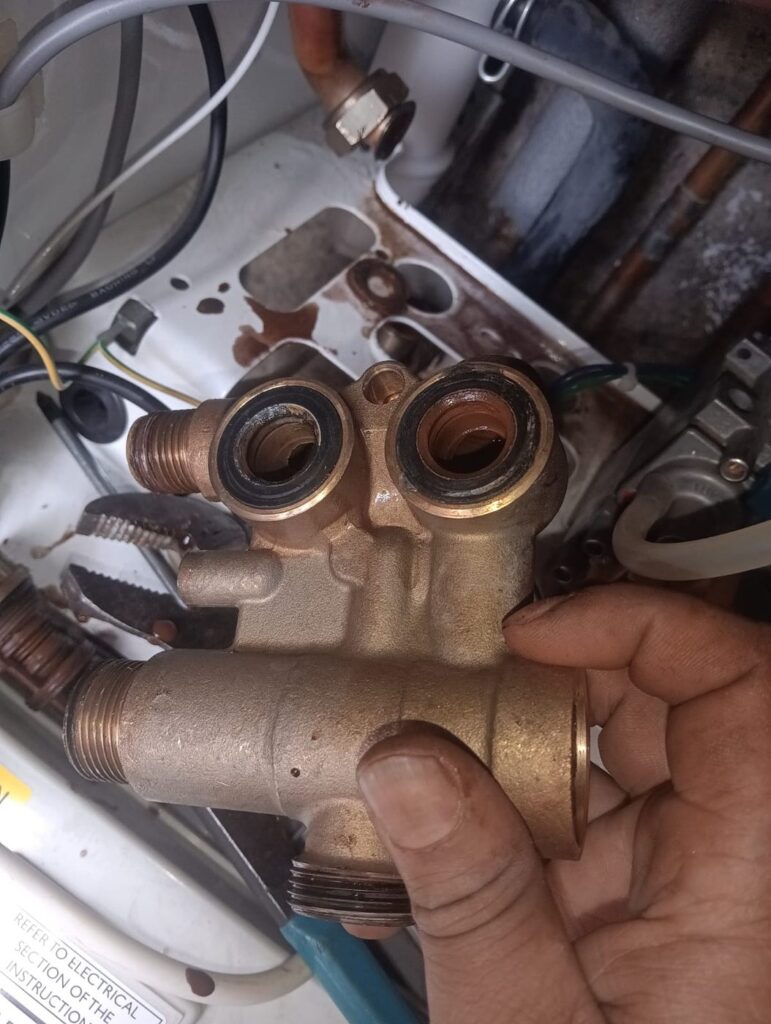
A fault code on the boiler display is the boiler trying to tell you what went wrong, in the only language it has: a letter and a number. To most people it means nothing, and the instinct is to press reset and hope. Sometimes that’s fine. But that short code is the single most useful clue anyone has about a boiler fault, and knowing roughly what it is pointing at changes what you do next. It can be the difference between a two-minute fix you do yourself, a sensible call to an engineer, and a boiler that keeps cutting out on cold mornings because nobody looked into it properly. Here’s how we read fault codes on real jobs across East London, what you can safely check yourself, and when it’s time to stop resetting and book a repair.
What is a boiler fault code actually telling me?
Every modern boiler checks itself constantly. Sensors watch the water pressure, the temperature of the water leaving and coming back to the boiler, whether the flame has lit and stayed lit, whether the fan is spinning at the right speed and whether the condensate can drain away. When one of those readings goes outside the range the manufacturer allows, the boiler stops what it’s doing, shows a code, and in many cases “locks out” until someone resets it.
The important thing to understand is that the code tells you which check failed, not which part is broken. A code that says “low water pressure” might mean the system really has lost water, or it might mean the sensor that measures pressure has failed and is reporting nonsense. That’s why the same code can need a top-up on one visit and a replacement part on another, and why an engineer will always test before fitting anything.
Codes also differ between manufacturers. An F1 on an Ideal Logic and an F.1 on another make aren’t the same fault, so always check the code against your own boiler’s manual or the manufacturer’s guidance before acting on it.
Should I write the code down before I press reset?
Yes, every time. On most boilers the code disappears as soon as you reset, and if the boiler then fires up normally you’ve lost the evidence. Take a photo of the display on your phone, note the time and what the heating was doing (heating on, running a tap, first thing in the morning), and pass it on when you book. An engineer who knows the code before they arrive can think about the likely parts in advance, and a pattern (“it’s always the same code, always first thing in the morning”) is often more useful than the code itself.
Which fault codes can I safely deal with myself?
A handful of common codes point at things a householder can check safely without opening the boiler casing:
- Low pressure codes — such as F.22 on many Vaillant boilers or F1 on an Ideal Logic. Look at the pressure gauge. If it’s below about 1 bar when the system is cold, the manufacturer’s instructions will show you how to top it up using the filling loop. If it drops again within days or weeks, there’s a leak or a failing part somewhere, and our guide to a boiler losing pressure explains where the water usually goes.
- Ignition failure codes — such as F.28 on a Vaillant. Check the gas is on at the meter and that other gas appliances work. In freezing weather, check the condensate pipe outside hasn’t frozen, as many boilers show an ignition or lockout code when it does. Our frozen condensate pipe guide shows how to thaw it safely, and the Vaillant F28 guide covers the other common causes.
- A blank display — not a code at all, but worth mentioning. Check the fused spur switch next to the boiler and whether anything else on that circuit has tripped. The boiler won’t turn on guide walks through the order to check things in.
One reset after you’ve checked the obvious is perfectly reasonable. What you should never do is take the casing off, bypass a safety device, or keep resetting a boiler that locks out again straight away. If you smell gas at any point, turn the supply off at the meter, open the windows and call the National Gas Emergency Service on 0800 111 999.
Which codes mean I need a Gas Safe engineer?
Anything that keeps coming back, anything that relates to the flame, the fan, the flue or the gas valve, and anything involving the boiler’s internal sensors. As a rule of thumb: if the code is still there after you’ve checked the pressure, the gas supply and the condensate pipe, it’s an engineer job. Here are a few real examples from the jobs we’ve attended this autumn, because they show how much the code alone can and can’t tell you.
A Vaillant showing F.22, with perfectly good pressure. On paper, F.22 points at low water pressure, and on most boilers that’s exactly what it is. On this job the gauge was fine, the system was full, and the boiler still insisted it was short of water. Testing traced the fault to the boiler’s main control board (the PCB) misreading the situation. The board was replaced and the fault cleared on the same visit. Topping up the pressure would never have fixed it, which is why a returning F.22 with a healthy gauge always needs testing rather than guessing.
A Vaillant ecoTEC Pro showing F.84. This code relates to the temperature sensors on the flow and return pipes. The boiler compares the two readings, and if they don’t make sense together it stops. Once the cause was confirmed it was repaired and the boiler put back into service, and it’s a good example of a code that sounds alarming and has nothing to do with gas at all.
An L1 lockout on a Pro Combi Exclusive that wouldn’t run at all. The culprit was the return temperature sensor, a small NTC thermistor clipped to the pipe returning water to the boiler. The part itself is small, but with a faulty one the boiler can’t trust its own temperature readings and won’t fire. New sensor fitted, boiler back in service.
A boiler that tripped the electrics every time the heating came on. No useful code at all this time, just a fuse that blew whenever the heating was called for. The customer had just moved into the property, and it had already been looked at once without a clear answer. The cause turned out to be incorrect wiring on the heating controls, not the boiler itself. Rewired and running. It’s a reminder that “the boiler is broken” is sometimes the controls, the wiring or the pipework around it, and only methodical testing tells you which.
If you have a Vaillant, our Vaillant F75 guide and Vaillant boiler repair page cover the codes we see most, and the Ideal boiler repair page does the same for Ideal models.
Why do some fault codes turn up more often in East London homes?
Two local factors come up again and again. The first is water. East London sits on some of the hardest water in the country, and limescale builds up inside combi boilers, particularly on the plate heat exchanger that heats your tap water. Scale makes the boiler run hotter than it should in places, which can trigger overheat and temperature-sensor codes, and it often shows first as hot water that goes lukewarm halfway through a shower.
The second is the housing itself. Many terraces in Bow E3 and Mile End were converted into flats decades ago, with boilers tucked into cupboards and long condensate runs going out through side returns or down light wells. Across Dagenham and Barking, a lot of RM10 and IG11 homes still have older steel pipework that sheds iron oxide sludge into the system. Sludge is hard on pumps and sensors, and a pump struggling to move water is behind plenty of circulation and overheat codes, including the F75 on many Vaillant boilers.
Is it worth repairing a boiler that keeps showing codes?
Usually, yes. Most fault codes trace back to one specific part — a sensor, a fan, a pump, a valve or a control board — and replacing that part puts the boiler back to normal. It only becomes a replacement conversation when the boiler is old enough that parts are getting hard to find, when several different faults keep appearing, or when the repair is a large share of what a new boiler would cost. We’ll always tell you which camp your boiler is in and confirm the cost before we start, so you can decide with the facts in front of you.
The easiest fault to deal with is the one that never happens, and an annual boiler service is where many of these faults get caught early: weak sensors, a scaled-up heat exchanger, a pump starting to labour, a condensate trap filling with debris.
Frequently asked questions
Will resetting my boiler clear the fault?
It clears the code from the display, not the cause. If the fault was a one-off (a brief gas supply interruption, say), the boiler may run normally afterwards. If it locks out again with the same code, stop resetting and book an engineer, and take a photo of the code first.
Is a boiler showing a fault code dangerous?
The code itself means the boiler’s safety systems are doing their job: it has detected something outside normal limits and shut down. What matters is not to override it. If you ever smell gas, or anyone at home has symptoms like headaches or dizziness that ease when they go outside, turn the gas off at the meter and call 0800 111 999.
Do fault codes mean the same thing on every boiler?
No. Each manufacturer uses its own codes, and they can vary between models from the same brand. Check your boiler’s manual, and when you call an engineer, give them the make, the model and the exact code.
How much does it cost to fix a boiler fault code?
It depends entirely on the part involved. Our boiler repairs start from £89, we confirm the cost before any work starts, and there’s no obligation. Our boiler repair page explains how we diagnose faults.
If your boiler is showing a code you can’t make sense of, or one that keeps coming back, call or WhatsApp us on 07927 882561 with the make, model and code. We work from two bases, 290 Devons Road in Bow E3 and Dagenham RM10, covering Bow, Mile End, Stratford, Isle of Dogs, Canary Wharf, East Ham, Barking, Dagenham, Rainham, Romford, Hornchurch, Upminster and Elm Park. Gas Safe registered (587401), repairs from £89, cost confirmed before we start, and no obligation. Our boiler repair page has more on how we work.
About the author: J. Ahmed is the founder of Gas First Ltd and a Gas Safe registered engineer (587401), working across East London since 2016.