If your combi boiler’s hot water is noticeably cooler in winter, the most common reasons are colder incoming mains water, a flow rate higher than the boiler can heat, limescale on the plate heat exchanger, or a temperature setting that has been turned down. Most of these can be checked in a few minutes, and the rest are routine engineer jobs. Every December we get the same call from homes across East London: “The heating’s fine, but the shower’s gone lukewarm.” Often the boiler isn’t failing at all. This guide explains what’s really happening, the checks you can safely do yourself, and when it’s time to get a Gas Safe registered engineer in.
Why is my combi hot water fine in summer but lukewarm in winter?
A combi boiler doesn’t store hot water. It heats cold mains water instantly as it passes through, so the temperature at your tap depends on two things: how cold the water is when it arrives, and how much water is flowing through the boiler at once.
In summer, mains water coming into an East London home is noticeably warmer than it is in December, when the pipes in the street are surrounded by cold ground. The boiler has to lift winter water through a much bigger temperature rise to reach the same shower temperature. If the boiler’s output is fixed and the flow stays the same, the water simply comes out cooler.
Here’s a rule of thumb we use on jobs. To warm water by about 35°C, a combi needs roughly 2.4kW for every litre per minute. That means a 24kW combi can manage something like 10 litres a minute at that rise, a 30kW combi about 12, and a 35kW combi around 14. Ask for more than that, by running a power shower and the kitchen tap together, for example, and the boiler can’t keep up. In summer, when the rise needed is smaller, you’d never notice. In winter you do.
How can I tell if my flow rate is too high for my boiler?
Try this simple check. Hold a bucket or a large jug marked in litres under the shower or the hot tap with it fully open, and time ten seconds. Multiply the litres by six to get litres per minute. Then look at the badge on your boiler, or its manual, for its hot water output in kW.
If you’re getting well over the figures above for your boiler size, the water will feel cooler on cold days. That’s not a fault, it’s physics. Sometimes the fix is as simple as an engineer setting the boiler’s flow restrictor correctly so the water comes out hotter at a slightly lower flow. If a household has genuinely outgrown a small combi, for instance after a loft conversion added a second bathroom, then it’s a conversation about whether the boiler suits the home, not about a repair.
One East London detail worth knowing: in many Bow and Mile End Victorian terraces, the boiler sits in the kitchen at the back of the ground floor and the bathroom is up two flights in what was once a box room. That long run of pipe, often partly through cold floor voids or an outside wall, loses heat before the water reaches you. In winter the first minute of a shower can feel far colder than the boiler is actually producing. Lagging accessible pipe runs helps more than most people expect.
Could limescale be making my hot water cooler?
In East London, very often yes. Our water is hard, and every time a combi heats water, a little of that hardness comes out as limescale. Inside the boiler, the hot water is heated by a compact plate heat exchanger with very narrow passages. As scale builds up in them, heat transfers less efficiently and the water at the tap gets cooler, swings between hot and warm, or takes longer to get hot.
From our jobs across Stratford, East Ham, Barking and Dagenham, the signs that point to scale are fairly consistent:
- Hot water that was fine a year or two ago has slowly become less hot, rather than failing suddenly.
- The temperature surges and dips during a shower while the flow stays steady.
- Crusty white deposits on your taps, shower head and kettle, which tell you how hard the water is in your home.
- A boiler that occasionally kettles, making a rumbling or ticking sound when it fires for hot water.
An engineer can descale or replace the plate heat exchanger. On many boilers it’s a straightforward part. Fitting a scale reducer on the cold supply into the boiler helps slow the problem down afterwards. It’s one of the reasons we always ask about hot water performance during a boiler service, rather than only checking that the heating works.
Is my boiler’s hot water temperature set too low?
Check this before anything else. Most combis have two separate controls on the front: one for the radiators and one for the hot water, usually marked with a tap symbol. It’s easy for the hot water setting to get knocked down, or to be turned down deliberately in the summer and forgotten.
Turn the hot water setting up a notch and run the tap again. If you have young children or elderly relatives at home, remember that very hot water can scald, and a thermostatic mixer on the shower is the safer way to get a comfortable temperature. A thermostatic shower valve that has scaled up can also make the shower feel cold even when the boiler is producing plenty of heat. If the kitchen tap nearest the boiler runs properly hot but the shower doesn’t, the shower valve is a likely suspect.
When is lukewarm hot water a sign of a boiler fault?
Sometimes the cause really is inside the boiler. These are the faults we find most often when hot water goes lukewarm on a combi:
- A sticking diverter valve. This valve switches the boiler’s heat between the radiators and the hot water. If it sticks part-way, some of the heat goes to the radiators while you’re running a tap. A telltale sign is radiators warming up when the heating is switched off and someone is in the shower. Our guide to no hot water but heating works covers this in more detail.
- A faulty flow sensor or temperature sensor. If the boiler can’t read the flow or the outgoing temperature properly, it can’t adjust the burner to match. You’ll often get hot-cold-hot swings.
- Low system pressure. On some boilers, pressure that’s drifting low affects how they run before they lock out entirely. Have a look at the gauge; our low boiler pressure guide explains what to look for.
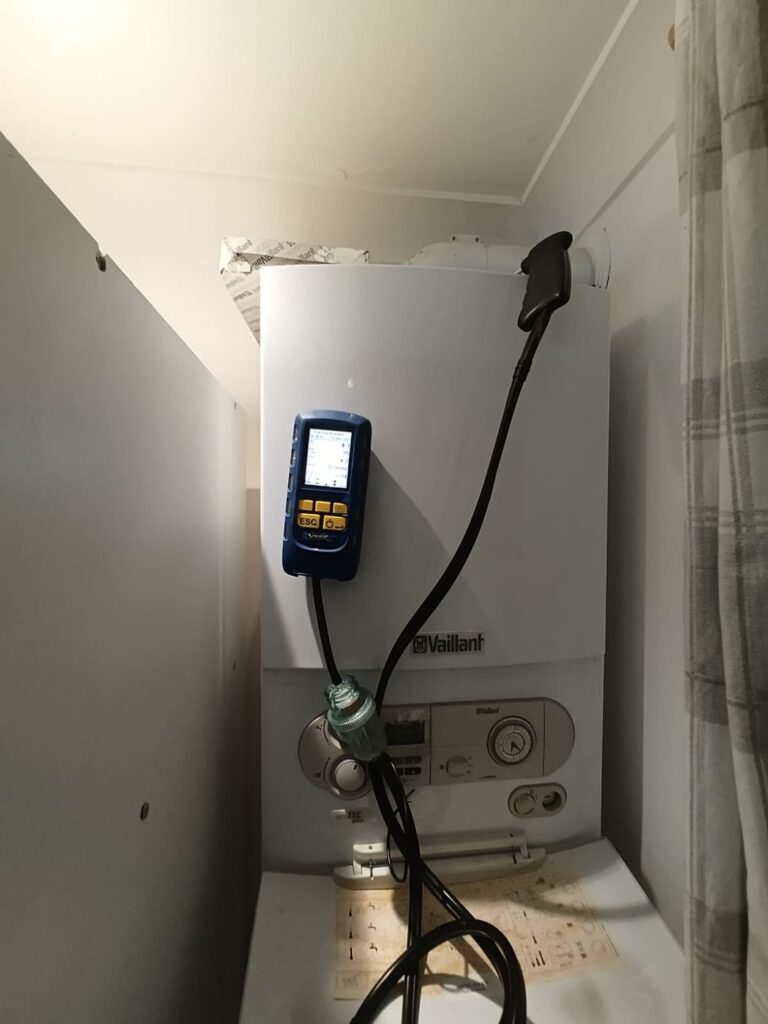
- A burner or gas-rate problem. If the boiler isn’t burning gas at the rate its data badge says it should, it can’t deliver its rated output. Only a Gas Safe registered engineer should check the gas rate and burner, and it’s part of every proper service we carry out.
Never take the casing off a boiler yourself. The internal parts carry gas and mains electricity, and the case seal is what keeps combustion gases out of your home.
What should I check before I call an engineer?
A few minutes of checks can save you a visit, or make one quicker:
- Turn up the hot water temperature control on the boiler and test again.
- Run the kitchen tap nearest the boiler on its own. If that’s hot but the shower isn’t, the problem may be the shower valve or pipe run, not the boiler.
- Measure the flow with a jug and stopwatch, and compare it with your boiler’s output.
- Check the pressure gauge is in the range shown in your manual, usually between about 1 and 1.5 bar when cold.
- Write down any fault code on the display, and the make and model of the boiler, before you ring anyone.
If none of that explains it, or the water is getting cooler week by week, it’s worth booking a repair before the coldest part of winter puts more load on the boiler. We repair all the common makes, including Vaillant, Worcester Bosch and Baxi. Our boiler repair page explains how we diagnose faults.
Is it time to replace a combi that can’t keep up?
Not usually. Lukewarm hot water on its own is rarely a reason to replace a boiler. Most causes are settings, scale or a single part. But if your combi is well past 12 to 15 years old, has a scaled heat exchanger alongside other recurring faults, or was undersized for your home from the start, it’s fair to compare the cost of repair against a replacement. We’ll give you both options plainly. New boilers start from £1,800 and we’re approved installers for Baxi, Vaillant and Glow-worm. You’ll find more on our boiler installation page.
Frequently asked questions
Why does my combi boiler’s hot water go cold in the middle of a shower?
The most common causes are a flow rate higher than the boiler can heat, someone else turning on a tap at the same time, limescale in the plate heat exchanger, or a faulty flow sensor or diverter valve. If it happens even when nothing else is running, have an engineer check it.
Is it normal for combi hot water to be cooler in winter?
A little, yes. Mains water arrives much colder in winter, so a combi has to work harder to reach the same temperature. If the difference is big, or getting worse, check the flow rate and the hot water setting, and ask about limescale at your next service.
Does hard water damage combi boilers?
Hard water causes limescale inside the boiler, especially in the plate heat exchanger that heats your hot water. Over time that reduces hot water performance. It’s common in East London, and a scale reducer plus regular servicing help.
How much does it cost to fix lukewarm combi hot water?
It depends on the cause. Some fixes are a settings change made during a visit; others need a part such as a diverter valve or plate heat exchanger. Our boiler repairs start from £89, we confirm the cost before any work starts, and there’s no obligation.
If your hot water isn’t what it was, we’re happy to take a look and give you a straight answer. Call or WhatsApp us on 07927 882561. We work from two bases, 290 Devons Road in Bow E3 and Dagenham RM10, covering Bow, Mile End, Stratford, Isle of Dogs, Canary Wharf, East Ham, Barking, Dagenham, Rainham, Romford, Hornchurch, Upminster and Elm Park. Gas Safe registered (587401), boiler service from £79, repairs from £89, cost confirmed before we start, and no obligation.
About the author: J. Ahmed is the founder of Gas First Ltd and a Gas Safe registered engineer (587401), working across East London since 2016.